Table of Contents
Introduction
Let’s be honest: the weekly ritual of dragging a heaving green bin to the curb is nobody’s idea of fun. You’ve spent your weekend mowing, pruning, and raking, only to be left with a mountain of grass clippings and leaves that could fill a small skip. It feels counterintuitive, right? You’re literally throwing away the very nutrients your garden is begging for.
What if you could make that “waste” disappear while creating something priceless for your garden?
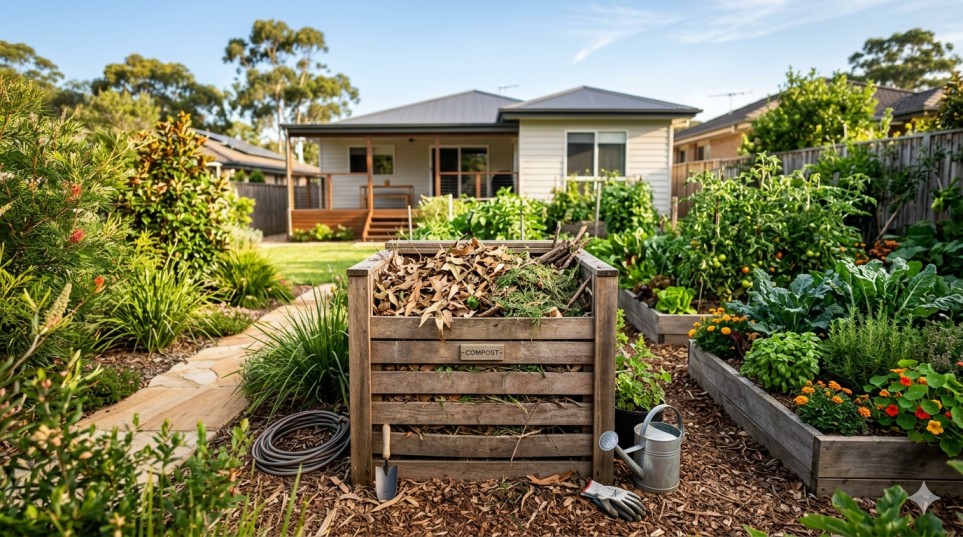
That’s where a yard waste compost bin comes in. It isn’t just a box for rotting leaves; it’s a self-contained recycling factory that turns your garden cleanup into free, nutrient-dense fertiliser. Whether you’re nurturing a sprawling backyard in the suburbs of Brisbane or a cozy courtyard in Melbourne, this guide will show you exactly how to choose, set up, and maintain the perfect compost bin for garden waste in our unique Australian climate.
What Is a Yard Waste Compost Bin?
Simply put, a yard waste compost bin is a designated container used to hold organic garden materials like leaves, grass clippings, and small prunings while they break down into compost. It’s a controlled environment designed to speed up the natural decomposition process .
Unlike an open pile that might blow across the neighbour’s fence or attract unwanted visitors, a bin keeps things tidy and efficient. It traps heat and moisture, which are the two engines of decomposition.
Types of Yard Waste Compost Bins at a Glance
While we’ll dive deeper into the options later, here is the quick lay of the land:
- Stationary Bins: The classic, no-fuss “set and forget” container.
- Tumbling Bins: Elevated barrels that spin for easy mixing.
- DIY Bays: Open-bottomed structures often made from recycled timber pallets or mesh .
- Worm Farms: A separate system that uses specific composting worms, ideal for kitchen scraps but less suitable for bulk yard waste.
Benefits of Using a Yard Waste Compost Bin
Why invest in a specific bin instead of just a pile? The benefits go far beyond just saving space.
1. You Save Real Money
Think about what you currently do with your garden waste. If you take it to the tip, you’re paying fees. If you use council green bins, you’re paying rates that are impacted by processing costs. Worse, if you bag it and bin it in the general waste (please don’t!), you’re filling up expensive landfill space. Processing organic waste in a landfill produces methane, a harmful greenhouse gas, and it costs councils and you more in the long run . A compost bin for garden waste creates a product that replaces expensive store-bought fertilisers and soil conditioners.
2. It Slashes Your Carbon Footprint
When grass clippings and leaves are buried in landfill, they decompose without oxygen (anaerobically). This process releases methane, a greenhouse gas far more potent than carbon dioxide. By composting at home, you’re allowing the material to break down with oxygen (aerobically), which significantly reduces harmful emissions .
3. Creates “Black Gold” for Australian Soils
Let’s face it much of Australia’s soil is, to put it politely, challenging. It’s either heavy clay that sets like concrete in summer, or hydrophobic sand that repels water like a raincoat. Compost is the great equalizer. It improves soil structure so water can penetrate deep into the root zone, rather than just running off into the stormwater drain .
Types of Yard Waste Compost Bins for Aussie Gardens
Not all bins are created equal, especially when dealing with the harsh Australian sun. Here’s how to choose the right outdoor compost bin for your space.
The Tumbler: The Speed Demon
These are sealed, barrel-shaped bins mounted on a stand. You add your waste, close the door, and give it a spin every few days.
Pros for Aussies:
- Pest-Proof: Completely sealed to keep out rodents and flies, even with kitchen scraps added .
- Odour Control: The tumbling aerates the mix, preventing the smelly, slimy anaerobic conditions common in our humid summers .
- Speed: With regular turning, you can have finished compost in as little as 4-6 weeks .
Cons:
- Capacity: Most tumblers hold less volume than a large stationary bin. Great for small to medium yards, but may not keep up with a large block dropping tonnes of autumn leaves.
The Stationary Bin: The Heavy Lifter
This is the classic, large-capacity plastic cone or square box that sits directly on the soil.
Pros for Aussies:
- Volume: You can pile up huge amounts of lawn clippings and autumn leaves.
- Worm Access: Because it sits on the ground, worms and microbes can enter freely from the soil to help break down the material .
Cons:
- Pests: You must ensure the base is buried 10cm deep or lined with mesh, as rodents love nesting in these warm piles .
- Turning Effort: You’ll need a compost aerator or garden fork to manually turn the pile it’s a bit of a workout in the summer heat.
The DIY Bin: The Aussie Battler
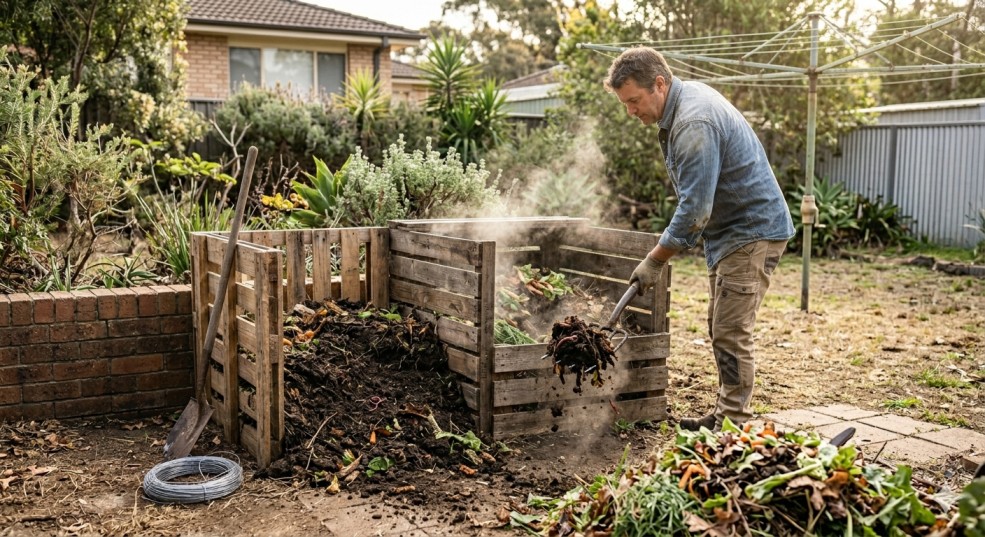
This is the true-blue, budget-friendly option. You can use recycled timber pallets, corrugated iron sheets, or chicken wire stretched between star pickets .
Pros for Aussies:
- Cost: Almost free if you use recycled materials.
- Customisation: You can build it to the exact size needed for the corner of your yard.
- Airflow: Open bays provide maximum airflow, essential for breaking down coarse Australian natives and gum leaves.
Cons:
- Pests: You’ll absolutely need to line the sides with fine wire mesh (aviary wire) to keep mice and rats out .
- Aesthetics: It can look a bit rough if not built neatly.
How to Choose the Best Yard Waste Compost Bin
Picking a bin in Australia requires thinking about our specific climate challenges. Here’s your checklist.
1. Location, Location, Location
- Summer Sun: Australian sun is brutal. Do not put a black plastic outdoor compost bin on a western-facing brick wall in full sun. You’ll cook the microbes and create a dust bowl. Aim for a spot with partial shade or morning sun only .
- Drainage: Ensure the site is level and well-drained. You don’t want your bin sitting in a puddle after a summer storm .
2. Size Matters
- Small Yard/Courtyard: A 160L to 200L tumbler is ideal. It keeps everything contained and prevents odours wafting into your entertaining area .
- Suburban Block: Go for a 300L+ stationary bin or build a DIY bay system. You’ll generate more garden waste than you think, especially in autumn.
3. Material Durability
- Look for BPA-free, UV-stabilised plastic. Cheap imported plastic bins can become brittle and crack after a few seasons of Australian sun exposure .
How to Use a Yard Waste Compost Bin (Step-by-Step)
This is the secret sauce. It’s not rocket science, but getting the balance right stops it from turning into a stinky swamp or a dry pile of sticks.
Step 1: Understand Greens vs Browns
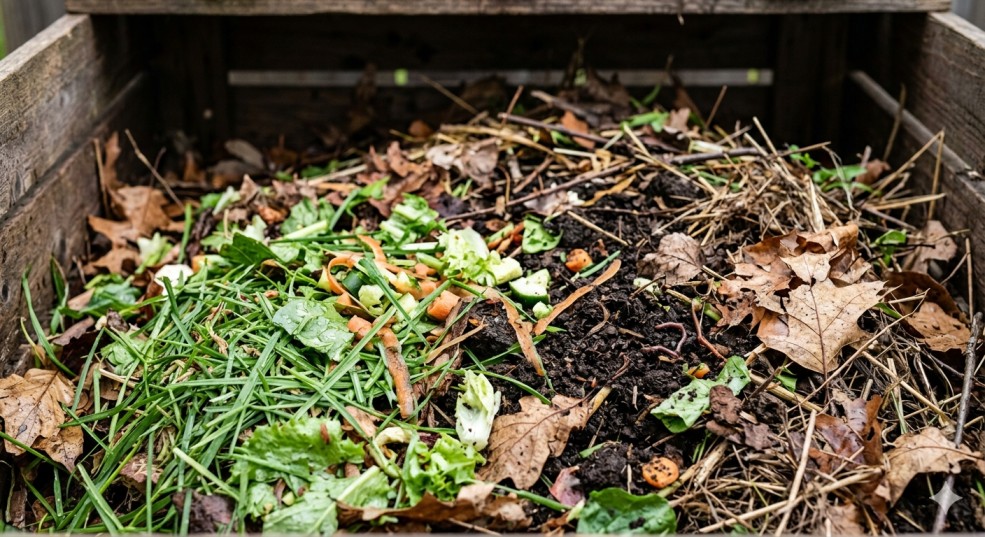
This is the golden rule of how to compost yard waste. Everything you add falls into one of two categories :
| GREENS (Nitrogen – The Fuel) | BROWNS (Carbon – The Structure) |
|---|---|
| Fresh lawn clippings | Dry autumn leaves |
| Vegetable scraps | Shredded paper/cardboard |
| Weeds (before seeding) | Sawdust (untreated wood) |
| Coffee grounds | Small twigs & prunings |
| Spent flowers | Straw/hay |
The Aussie Tip: During wet La Niña summers, grass grows like crazy and becomes a “wet green.” You’ll need twice as much Brown material to stop the bin turning into slime. During dry El Niño summers, grass clippings might already be half-dry, so you need more Greens (water) to get things going.
Step 2: The Layering Method
Think of it like making a lasagna for your garden.
- Base Layer: Start with 10-15cm of Browns (sticks or coarse mulch) at the bottom. This lifts the pile off the ground and creates airflow .
- Add Materials: Alternate thin layers of Greens (kitchen scraps, grass) and Browns (shredded paper, dry leaves) .
- Ratio: Aim for roughly 1 part Greens to 2-3 parts Browns by volume .
Step 3: Moisture Control
Your pile should feel like a wrung-out sponge .
- If it’s dripping wet: Add more dry Browns (shredded cardboard is magic for this) and leave the lid off for a few hours.
- If it’s dusty dry: Give it a sprinkle with the hose. In Australian summer, you might need to water your compost pile just like you water your plants.
Step 4: Turning the Pile
Microbes need oxygen. If you have a tumbler, spin it 3-4 times every few days. If you have a stationary bin, use a compost screw or garden fork to mix the layers every 1-2 weeks. This prevents it from compacting into an airless, smelly brick.
What Can and Cannot Go in a Yard Waste Compost Bin
A general rule: If it was once part of a living plant, it can probably go in .
✅ YES – Add These:
- Grass clippings and dry leaves
- Hedge trimmings and small prunings (chopped up)
- Fruit and veggie scraps (including citrus and onion peels in a healthy bin)
- Coffee grounds and loose tea leaves
- Eggshells (crushed)
- Shredded newspaper and plain cardboard
❌ NO – Keep These OUT:
- Meat, fish, bones, and dairy: They rot, stink, and attract rats and maggots .
- Pet poo: Risk of spreading parasites and disease to your veggie patch .
- Weeds with seeds/bulbs: Unless your bin gets really hot, these will survive and spread everywhere you use the compost .
- Treated timber: Contains chemicals that poison soil life.
- Large woody branches: They take years to break down. Save those for the council collection or a fire pit.
Common Mistakes to Avoid
Even experienced gardeners slip up. Here’s how to troubleshoot your compost bin for garden waste.
- The Smelly Bin (Ammonia/Rotten Eggs): Problem: Too many Greens (nitrogen) and not enough air. Fix: Add a bucket of dry Browns (shredded paper/leaves) and turn the pile vigorously .
- The Bone-Dry Pile: Problem: Our hot Aussie sun is evaporating all the moisture. Fix: Water the pile until damp, then cover it with a piece of old carpet, hessian sack, or a plastic tarp to lock in humidity .
- The Fruit Fly Swarm: Problem: Kitchen scraps exposed on top. Fix: Always bury food scraps under at least 10cm of Browns or finished compost. This acts as a natural odour filter .
DIY Yard Waste Compost Bin (The Weekend Project)
You don’t need to spend $200 at a hardware store. Here is the simplest, most effective DIY design for Aussie yards.
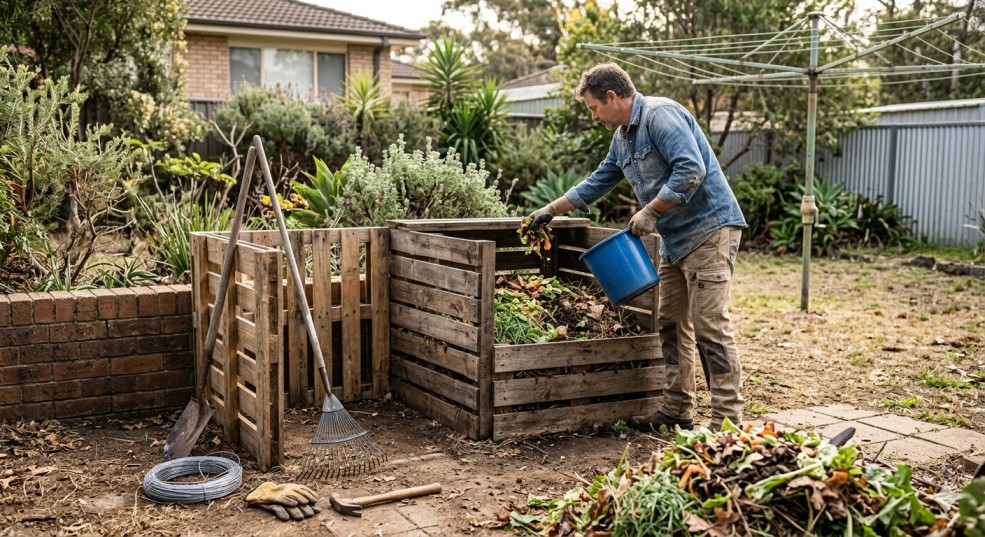
The Pallet Bay System
You need two or three untreated wooden pallets (look for the “HT” stamp, meaning Heat Treated, not chemical treated).
- Form a U-Shape: Stand two pallets up on their edges to form the side walls. Use a third for the back wall.
- Secure: Tie the corners together with strong wire or heavy-duty zip ties.
- Pest Proof: Staple aviary mesh (small gauge chicken wire) to the inside of the pallets. This is non-negotiable if you live near bushland or want to keep rats out .
- Front: Leave the front open for easy access to turn the pile.
Tips for Faster Composting in Australia
We live in a land of extremes. Here’s how to work with the climate, not against it.
- Summer Strategy: During heatwaves (30°C+), a black plastic bin can act like an oven. That’s great for killing weed seeds, but it also dries out fast. Shade is your friend. Place the bin under a deciduous tree that offers summer shade but winter sun.
- Winter Strategy: In cooler climates like Tassie or the Victorian Highlands, composting slows right down. Help it along by:
- Chopping everything smaller: The more surface area, the faster microbes work .
- Insulating: Throw an old doona or wool blanket over the bin to hold in the heat generated by the microbes.
- Adding Manure: A handful of aged chicken manure is like a shot of espresso for your compost pile, heating it up instantly .
Conclusion
A yard waste compost bin is more than just a container it’s the cornerstone of a sustainable, thriving Australian garden. It closes the loop on your property’s waste, turning the chore of yard cleanup into a rewarding cycle of renewal.
You don’t need to be a green-thumbed wizard to do this. Start small, get the balance of Greens and Browns roughly right, and let nature do the heavy lifting. Whether you buy a sleek tumbler or knock together a pallet bay, you’re stepping off the treadmill of endless green bins and giving back to the soil that feeds you.
Ready to start turning waste into garden gold? Grab a bin, save that first bucket of kitchen scraps, and start building your pile today.
Frequently Asked Questions (FAQ)
Q: How long does it take for yard waste to turn into compost?
A: It depends entirely on the system and effort. In a tumbler during an Australian summer, you can have finished compost in 4-6 weeks if you turn it regularly . In a stationary bin left unturned over winter, it might take 6-12 months. To speed it up, chop materials small and ensure the pile stays moist .
Q: Will a compost bin attract snakes?
A: Compost piles can provide warmth and attract rodents, which in turn might attract snakes. To minimise risk:
- Keep the bin in an open area away from thick bushland.
- Crucial: Never add meat, fish, or dairy.
- Ensure the base and sides have fine wire mesh to prevent rodent entry .
- Turn the pile regularly; snakes prefer undisturbed, quiet piles.
Q: Can I put gum leaves in my yard waste compost bin?
A: Yes, but with a warning. Eucalyptus leaves contain oils that slow down decomposition. They are excellent “Brown” (carbon) material, but they break down much slower than deciduous leaves. Tip: Run the mower over them first to shred them up, or soak them in a bucket of water with a dash of detergent (to break surface tension) before adding them to the pile.
1 thought on “How a Yard Waste Compost Bin Transforms Your Aussie Backyard (and Saves You Money)”