
Table of Contents
Introduction
Have you ever paused before scraping that banana peel or those sad-looking spinach leaves into the bin? You’re not alone. For most Aussie households, food scraps and garden clippings make up nearly half of what we throw away . Every carrot top or pile of lawn clippings tossed in the red bin ends up buried in a landfill. There, without air, it rots and releases methane, a greenhouse gas far nastier than carbon dioxide .
But what if you could turn that “waste” into something incredibly valuable? That’s exactly what happens when you start using a compost bin. It’s not just about reducing rubbish; it’s about creating a free, nutrient-packed superfood for your soil. In a country known for harsh sun and sandy soils, that “black gold” is worth its weight in, well, vegetables.
If the idea of using a compost bin sounds technical or smelly, I’ve got good news: it’s actually pretty simple. Think of it like following a basic recipe. Once you nail the ingredients, nature does the heavy lifting. Let’s walk through everything you need to know to get started with backyard composting right here in Australia.
What Does Using a Compost Bin Actually Mean?
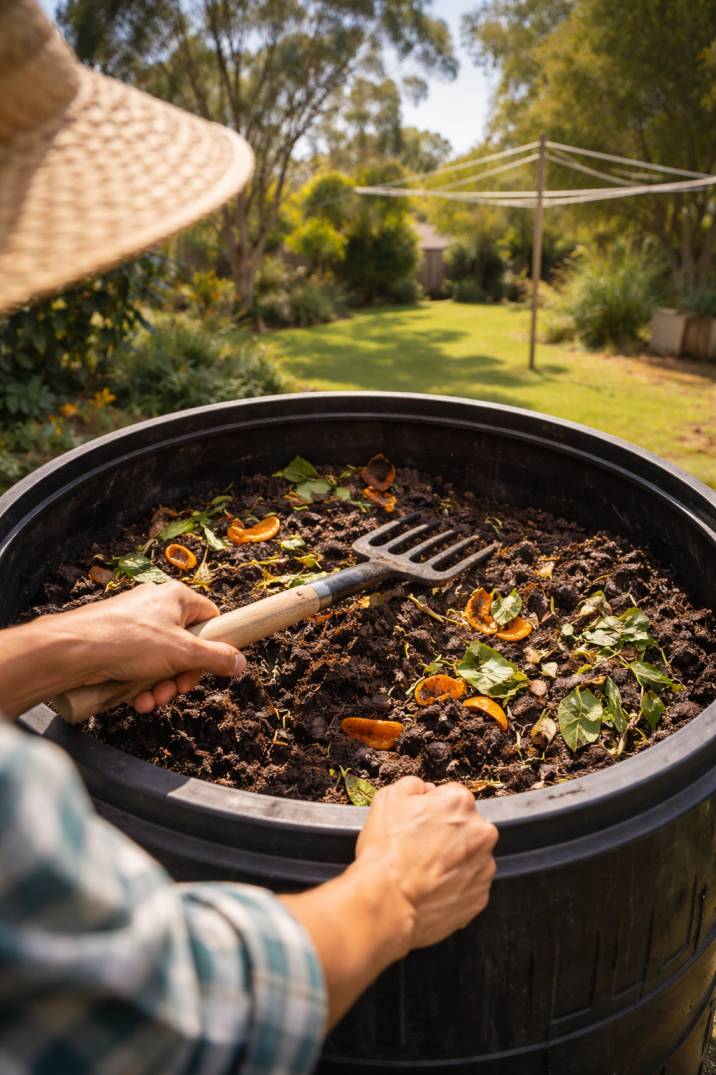
Put simply, using a compost bin means giving your kitchen scraps and garden waste a dedicated space to break down naturally. Instead of letting organic matter rot in a plastic bag at the tip, you’re creating the perfect environment for microbes, worms, and good bacteria to feast.
It’s a controlled version of what happens on a forest floor. Leaves fall, twigs drop, and eventually, they become part of the rich, dark soil. Using a compost bin just speeds up that process and keeps it tidy. It’s nature’s recycling system working right in your own backyard .
Why Bother? The Benefits of Using a Compost Bin in Australia
If you’re still on the fence about whether using a compost bin is worth the effort, let’s look at what you stand to gain.
- You’ll Drastically Reduce Your Waste: Remember that 50% stat? Using a compost bin means that instead of that waste costing the environment (and your council rates), it becomes a resource for your garden .
- You’ll Fix Your Soil for Free: Australian soil can be tricky, often sandy near the coast or hard-packed clay inland. Compost is the ultimate fixer. It helps sandy soil hold water and breaks up clay to help roots breathe. Stop spending money on bags of soil improver and make your own.
- It Feeds Your Plants Naturally: Compost is packed with slow-release nutrients. Unlike synthetic fertilisers that can wash away with a heavy downpour, compost feeds your plants gently over time and encourages healthy root growth.
- It Saves Water: In our climate, water is precious. Soil rich in compost acts like a sponge, holding moisture much longer. This means less time standing around with the hose, a win for your plants and your water bill.
- It’s Eco-Friendly: By using a compost bin, you’re actively cutting methane emissions from landfill and keeping harmful leachate out of the groundwater .
Choosing Your Weapon: Types of Compost Bins
Before you start using a compost bin, you need to pick one that suits your space. In Australia, you generally have four main options:
The Classic Plastic Standing Bin
This is the workhorse of Aussie backyards. It’s affordable, often available at a discount through your local council, and does the job well. It sits directly on the soil so worms can crawl up and get to work. Best for: Suburban blocks with a patch of dirt.
The Tumbling Bin
This is a barrel mounted on a stand. It’s off the ground, which is great news if you’re worried about rats or mice finding a way in. Every few days, you just give the handle a spin to mix everything up, no shovel required. Best for: Courtyards, paved areas, or anyone who wants quick results without the backache.
The DIY Bay
If you’ve got the space and generate a lot of green waste (think big lawns and big veggie patches), a three-bay system made from old pallets is the dream. You move the material from one bay to the next as it breaks down . Best for: Larger properties and keen veggie growers.
Worm Farm (The Small Space Hero)
Okay, technically this isn’t using a compost bin in the traditional sense, but it’s a fantastic companion. A worm farm uses specific “tiger” or “red” worms to eat through scraps super fast. They produce incredible liquid fertiliser. Best for: Apartment balconies or anyone with very little outdoor space.
The Golden Rule: Greens vs Browns (What to Put In)
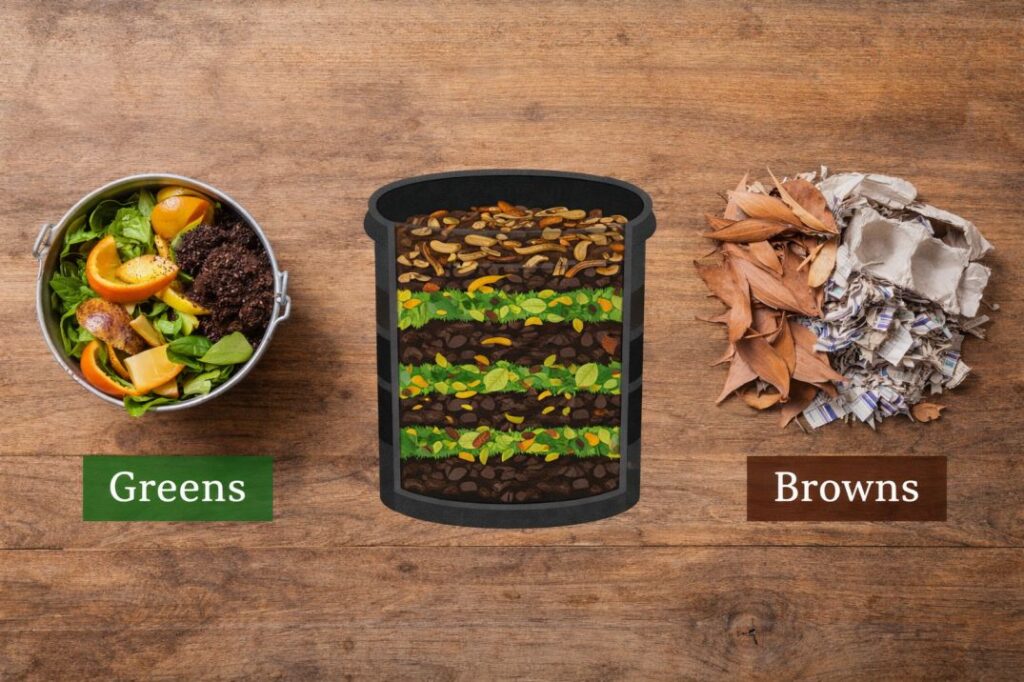
This is the most common hurdle for beginners using a compost bin, but it’s simple. Everything you add is either a Green (nitrogen) or a Brown (carbon). You need both to keep the party going.
Think of Greens as the juicy, wet fuel. Think of Browns as the dry, fluffy air pockets that stop it from becoming a slimy mess. A good ratio to aim for is roughly 1 part Greens to 2 parts Browns .
Here’s your cheat sheet for using a compost bin in Australia:
GREENS (Nitrogen-Rich)
- Fruit and veggie scraps (yes, even citrus and onion in moderation )
- Fresh lawn clippings
- Coffee grounds and tea leaves
- Garden prunings and spent flowers
- Chicken manure (from your backyard chooks)
BROWNS (Carbon-Rich)
- Dry autumn leaves
- Shredded newspaper or plain cardboard (remove the tape!)
- Straw or sugar cane mulch
- Egg cartons (torn up)
- Sawdust (from untreated wood)
What to AVOID Putting in Your Bin
While using a compost bin is forgiving, some things invite trouble like rats, maggots, or nasty smells in the Aussie heat:
- Meat, fish, and bones: Absolute magnets for vermin .
- Dairy products: Cheese, milk, butter they go rancid and stink.
- Oils and fats: They coat everything and stop it breaking down.
- Pet poo: Can contain harmful pathogens you don’t want near your veggie patch.
- Diseased plants or weeds with bulbs: You might spread the problem around your garden later.
Step-by-Step: Your Guide to Using a Compost Bin
Ready to get your hands dirty? Here’s how to start using a compost bin the right way from day one.
Step 1: Choose the Perfect Location
In Australia, the sun can bake a compost pile dry in no time. Find a spot that gets dappled shade under a deciduous tree is perfect. You want it directly on bare soil or lawn so earthworms and bugs can enter from below. Make sure it’s close enough to the kitchen that you won’t dread the walk in the rain.
Step 2: Pest-Proof the Base
This is a crucial Aussie step. Before you place your bin, lay down a square of sturdy wire mesh (about 1cm grid size) on the ground. Place the bin on top. This lets worms in but stops mice and rats from tunnelling up through the bottom.
Step 3: Build Your Base Layer
Don’t just start throwing in kitchen scraps. Start with a layer of Browns at the bottom, small twigs, woody prunings, or straw. This acts like a drain, allowing air to circulate so the pile doesn’t go soggy and suffocate .
Step 4: Add Greens and Browns in Layers
Now, start adding your scraps. Every time you empty your kitchen caddy full of “Greens,” cover it with a generous handful of “Browns.” Imagine you’re making a lasagne. The dry Brown layer on top acts like a lid, it traps moisture and suppresses any potential smells or flies .
Step 5: Manage Moisture (The Squeeze Test)
Using a compost bin in Australia often means battling dryness. The microbes need water to survive. Grab a handful of the mixture and squeeze. It should feel like a damp sponge, moist but not dripping wet .
- Too Dry? Give it a good soaking with the hose. Summer heat evaporates moisture fast.
- Too Wet? (More common in tropical QLD/NSW). Add more shredded paper or dry leaves and leave the lid off on a sunny day.
Step 6: Aerate Regularly
This is the secret to fast compost. You need to get air into the middle. You don’t have to flip it with a fork like a madman. You can buy a cheap “compost corkscrew” from Bunnings, you just twist it in and pull it up to create air channels . A PVC pipe drilled with holes stuck in the middle works brilliantly too . Turn every 2-4 weeks.
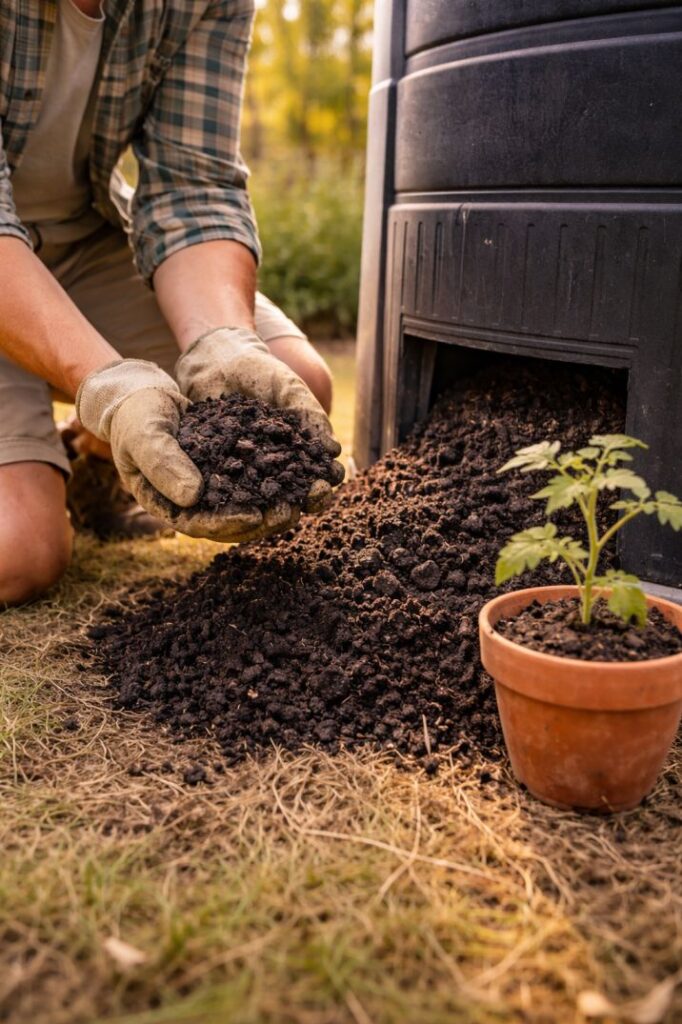
Step 7: Harvesting Your “Black Gold”
When the stuff at the bottom looks dark, crumbly, and smells like a rainforest floor, it’s ready. This usually takes 3 to 6 months. Stop adding new material for a few weeks to let the bottom layer finish. Most plastic bins have a little hatch at the base to scoop it out .
Common Mistakes When Using a Compost Bin (And How to Fix Them)
- Problem: It smells like rotten eggs.
- Cause: Too much nitrogen (Greens) and not enough air. It’s gone anaerobic .
- Fix: Add a thick layer of Browns (shredded paper/dry leaves) and turn it vigorously with a fork to let oxygen in.
- Problem: It’s full of slaters or cockroaches.
- Cause: It’s too dry or has too many woody Browns.
- Fix: Give it a good drink of water and add a layer of fresh lawn clippings or veggie scraps to heat it up. Cockroaches usually live in dry, cool piles .
- Problem: Nothing is breaking down. It looks the same as it did a month ago.
- Cause: Too dry, or pieces are too big.
- Fix: Chop up those broccoli stalks and corn cobs into smaller pieces. More surface area = faster eating for bacteria .
Tips for Faster Composting in the Aussie Climate
Using a compost bin down under comes with unique challenges. Here’s how to master it season by season:
- Summer: Keep it damp! The sun is relentless. If a heatwave is coming, drape a wet hessian sack or old towel over the pile under the lid to act as evaporative cooling. Turn it less often in extreme heat to stop moisture loss.
- Winter: Compost slows down when it’s cold. Don’t worry; it’s just hibernating. Insulate the outside of the bin with cardboard or straw bales. You can also add a handful of chook poo or coffee grounds as a “hot water bottle” to wake up the bacteria .
- Tropics (Northern Australia): The challenge here is heavy rain. If the monsoons hit, ensure your bin lid is secure and consider throwing a tarp over it temporarily to stop it becoming a swamp. Add plenty of coarse Browns to keep air pockets open.
FAQs: Your Compost Questions Answered
How long does it take for compost to be ready?
In a well-managed bin in Australia, you can have usable compost in 2 to 4 months during the warmer months. In winter, it can take 6 months or more . You know it’s ready when it’s dark brown, crumbly, and you can’t recognise the original ingredients.
Why does my compost smell?
Smell almost always means too wet and too much nitrogen (food scraps). It needs air. Turn it with a fork to fluff it up and mix in plenty of dry brown material like shredded paper or autumn leaves .
Can I compost in winter in Australia?
Absolutely. The process just slows down because the microbes go to sleep in the cold. Keep adding to the bin, but you won’t get finished compost until the weather warms up again in spring .
Do compost bins attract rats in Australia?
They can, but they shouldn’t if you follow the rules. Never add meat, bread, or cooked food. Always place wire mesh under the bin. And keep the pile active, a regularly turned bin is less appealing than a quiet, undisturbed pile of warmth .
Ready to Start Using a Compost Bin?
Using a compost bin is one of those small backyard changes that has a massive ripple effect. You’ll put less waste out on the kerb, save money on fertiliser and soil conditioners, and give your plants the best natural diet possible.
Start simple. Get a bin, put down your wire mesh base, and begin layering those greens and browns. You might feel like a mad scientist at first, but before you know it, you’ll be digging out handfuls of dark, sweet-smelling soil, and wondering why you didn’t start using a compost bin years ago.
Happy gardening!
Looking for more ways to improve your patch? Check out our guide to DIY garden soil mixes or read about managing yard waste sustainably.