
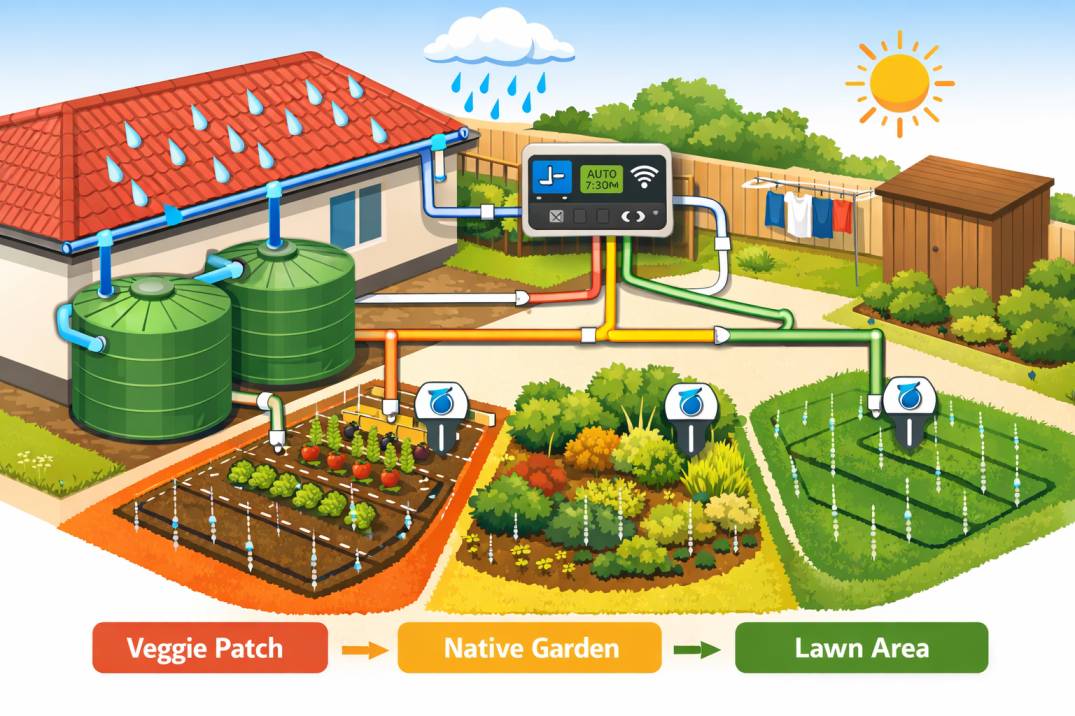
Water wise backyard Australia, it sounds like a humble goal, doesn’t it? Just saving a bit of water here and there. But what if I told you it’s something much more powerful? What if your backyard could become a self-sustaining ecosystem that not only survives but thrives through drought, heatwaves, and water restrictions?
G’day, I’m Mehedi. For the past decade, I’ve been transforming my suburban Melbourne block into what my neighbours now call “the oasis that never thirsts.” Through trial and error (plenty of error), I’ve discovered that creating a truly water wise backyard Australia isn’t about sacrifice. It’s about creating abundance, abundance of life, beauty, and resilience.
This isn’t just another gardening article. This is your blueprint for building a complete water-wise system, from the rainwater that hits your roof to the last drop that nourishes your plants. We’re going to connect the dots between drought tolerant garden design, smart irrigation, and clever water harvesting to create something extraordinary.
Table of Contents
Why This System Approach Changes Everything
Most gardening advice gives you pieces of the puzzle: “plant natives here,” “add mulch there.” But without seeing how everything connects, you’re left with a patchwork that never reaches its full potential.
The breakthrough came for me during the Millennium Drought. Watching my conventional garden struggle despite my efforts, I realised I wasn’t gardening, I was in a constant battle against the Australian climate. The solution wasn’t working harder, but working smarter by creating a system where every element supported the others.
Your water wise backyard Australia should work like a natural watershed. Rain is captured, stored, distributed efficiently, used by appropriate plants, and any excess is returned to the system. When you get this right, something magical happens: your garden begins to care for itself.

Part 1: The Foundation – Understanding Your Site
Reading Your Landscape Like a Book
Before we install a single tank or plant a single shrub, we need to become detectives. Your property is already telling you its water story, you just need to learn to listen.
The Slope Test
Grab a tennis ball and place it in various spots around your yard. Which way does it roll? Even gentle slopes dramatically affect water movement. I discovered my “flat” backyard actually had a 15cm fall from back to front – meaning every watering session was essentially hydrating my front fence more than my plants.
The Soil Investigation
Dig three test holes about 30cm deep in different areas:
- Near the house
- In the middle of the lawn
- In your proposed garden beds
Take a handful of soil and give it a squeeze:
- Does it form a sticky ball? You’ve got clay.
- Does it crumble immediately? That’s sandy soil.
- Does it hold together but break apart easily? Goldilocks soil – you lucky thing!
My own investigation revealed I had three different soil types across my 600-square metre block. No wonder my one-size-fits-all watering approach was failing.
The Sun Map Challenge
For one clear day, mark out where shadows fall at 9am, 12pm, and 3pm. You’ll discover microclimates you never noticed. That sunny spot you planned for veggies might only get 4 hours of direct sun. That shady corner you wrote off might be perfect for certain native ferns.
The Australian Climate Reality Check
We’re gardening on the world’s driest inhabited continent, but that doesn’t tell the whole story. Australia has six distinct climate zones, and your water wise backyard Australia system needs to respect your local reality.
The Tropical Challenge (Northern Queensland, NT)
- Annual rainfall: 1,200-2,000mm
- The twist: It all falls in 4 months
- System priority: Massive capture and storage for the dry season
The Arid Reality (Most of WA, SA, NT interior)
- Annual rainfall: Less than 250mm
- The twist: Unpredictable and evaporates quickly
- System priority: Maximum efficiency, zero waste
The Temperate Balance (VIC, NSW coast, TAS, SA coast)
- Annual rainfall: 500-1,000mm
- The twist: Increasingly unreliable with climate change
- System priority: Flexible systems that handle both dry spells and downpours
I garden in Melbourne’s temperate zone, where we’re experiencing what scientists call “season shift”, our reliable winter rains are becoming less predictable, forcing a complete rethink of traditional gardening calendars.
Part 2: The Capture System – More Than Just a Tank
Rainwater Harvesting: Your First Defence Line
When I installed my first rainwater tank for backyard Australia use, I made the classic beginner’s mistake: I bought what fit the space, not what met my needs. After the first summer, I realised my 2,000-litre tank was emptying in three weeks.
Sizing Your Tank Properly
Use this simple formula:
- Calculate your roof catchment area (Length × Width in metres)
- Multiply by your local rainfall (mm) × 0.8 (efficiency factor)
- Decide how much of that you want to capture
For example, my 100m² roof in Melbourne (650mm annual rain) yields:
100 × 650 × 0.8 = 52,000 litres annually
But here’s the crucial part: tanks aren’t just for storage; they’re for timing. You need enough capacity to get you through your longest dry period. In Melbourne, that’s typically 6-8 weeks in summer. My garden uses about 500 litres per week in peak summer, so I needed at least 4,000 litres of accessible water.
The Tank Setup Most People Miss
- First Flush Diverter: Essential for roof hygiene. This simple device discards the first dirty water from each rain event.
- Leaf Eaters & Gutter Mesh: Keep debris out without reducing flow
- Multiple Tank Linking: Instead of one massive tank, consider linking smaller ones at different downpipes. This spreads weight and captures from more roof area.
I now have three linked tanks totalling 7,500 litres, and they’ve never all been empty at once. For smaller spaces, our guide to the best rainwater tank Australia small backyard solutions can help you maximise every centimetre.
Beyond the Tank: Unexpected Water Sources
The Air Conditioning Goldmine
Your air conditioner produces condensation, pure distilled water. My split system produces about 10-15 litres per day in summer. I’ve piped mine directly into my garden’s smart irrigation system. It’s not enough to run everything, but it’s perfect for topping up my potted citrus.
Greywater: The Controversial Resource
Let’s talk straight about greywater system for garden Australia use. It can be brilliant or disastrous.
What works:
- Shower water (if you use simple, plant-friendly soaps)
- Laundry water from the rinse cycle
- Bath water (cooled first)
What doesn’t:
- Kitchen water (too greasy)
- Nappy rinse water
- Water with bleach or strong disinfectants
I use a simple diverter kit from my laundry that cost under $200. It only goes to my established fruit trees and lawn area – never to vegetables or delicate natives. The key is rotation: I only use greywater on an area for a month, then switch to rainwater to flush any salt buildup.
The Winter Window: Recharging Soil Moisture
Here’s a technique most gardeners miss: in winter, when my tanks are full, I deliberately overflow them into specific garden areas through simple surface channels. This deep-soak recharges the subsoil moisture, creating a reservoir that plants can tap into come summer. It’s like putting money in the bank during the rainy season.
Part 3: The Distribution Network – Smart Water Delivery
Drip Irrigation: Getting Surgical with Water
When I first installed a drip irrigation system Australia backyard style, I made every mistake in the book. I ran single lines too long, didn’t use pressure compensators, and tried to water shade-loving plants and sun-lovers on the same schedule. The results were… educational.
The Professional Layout Your Garden Deserves
After consulting with irrigation specialists and wasting about $500 on failed setups, here’s what actually works:
Zone by Plant Type, Not by Location
- Zone 1: Vegetables and annuals (daily watering in summer)
- Zone 2: Established shrubs (2-3 times weekly)
- Zone 3: Natives and drought-tolerant plants (weekly or less)
- Zone 4: Pots (daily but short runs)
Pressure Matters More Than You Think
Most suburban water pressure is too high for drip systems. A $25 pressure regulator will prevent blown fittings and ensure even watering across your system.
The Emitter Choice Conundrum
- 2L/hour emitters: Perfect for most shrubs and garden beds
- 4L/hour emitters: Better for trees and larger plants
- Inline dripline: Best for vegetable beds and hedges
- Micro-sprays: Only for pots or very specific situations
I now use a hybrid system: inline dripline in my vegetable beds and individual emitters for my fruit trees and specimen shrubs. Each zone has its own valve and runs on a different schedule.
Smart Controllers: The Brain of Your Operation
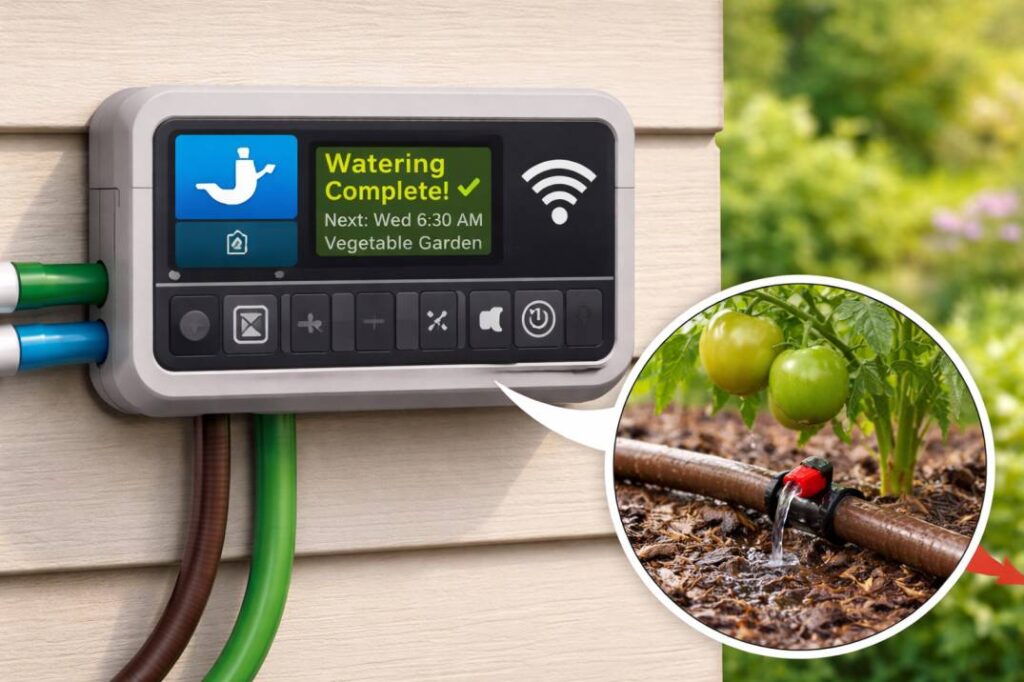
A smart irrigation controller isn’t a luxury – it’s what separates a system from a collection of pipes. After trying three different models, I’ve settled on one that connects to both weather forecasts and soil moisture sensors.
How Much Water Are You Really Saving?
With my current setup:
- Weather adjustment: Saves 15-25% by skipping watering before/after rain
- Soil moisture feedback: Saves another 30-40% by only watering when needed
- Flow monitoring: Alerts me to leaks (saved me from a 10,000-litre leak last year)
That’s potentially 55-65% less water used compared to a traditional timer system.
The Budget-Friendly Smart Alternative
If a $500 smart controller isn’t in your budget, start with a simple $80 timer and add a rain sensor for $40. This combination will save you 20-30% immediately. You can explore more backyard irrigation ideas Australia style in our dedicated guide.
The Hand Watering Reality Check
No system eliminates hand watering completely – and that’s a good thing. Walking your garden with a hose is how you notice problems early: that wilted plant, that suspicious leaf, that dry patch.
My rule: I hand-water my vegetable seedlings and new plantings for their first month. This ensures they get exactly what they need while their roots establish. After that, they graduate to the drip system.
Part 4: The Living Sponge – Soil and Plants That Work With You
Building Soil That Holds Water Like a Sponge
Australian soils are famously challenging, but we can work with what we’ve got. The goal isn’t to fight your native soil, but to gradually improve its structure.
The Australian Soil Transformation Method
I’ve developed this approach over 10 years of improving my heavy clay:
Year 1: The Breakthrough
- Autumn: Apply gypsum (2kg per 10m²) and water in
- Winter: Sow a green manure crop (rye corn or broad beans)
- Spring: Turn in the green manure, add 10cm of compost
- Summer: Mulch heavily and plant hardy pioneer species
Year 2: The Building Phase
- Add 5cm of compost each season
- Continue with green manure in unused beds
- Introduce worms (they’ll come naturally if you build good soil)
Year 3: The Maintenance Phase
- Twice-yearly compost top-ups (3cm)
- Permanent mulch layer
- Liquid feeds during growing season
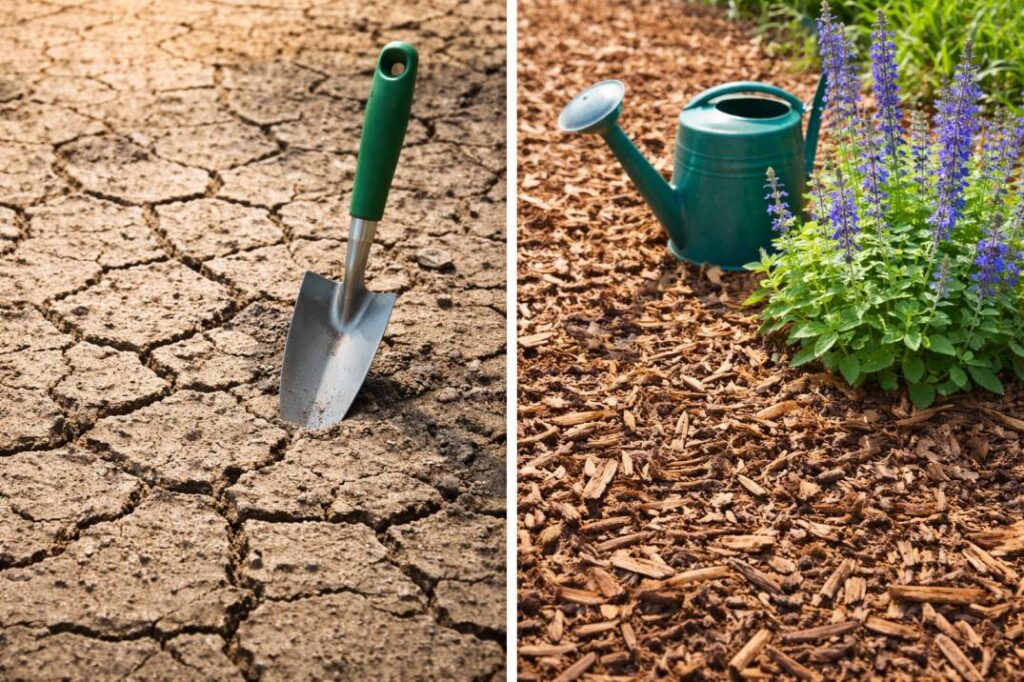
The result? Soil that can hold moisture through a week of 35°C days instead of turning to concrete in 24 hours.
The Mulch Matrix: Choosing Your Moisture Blanket
| Mulch Type | Best For | How Thick | How Often | Cost |
|---|---|---|---|---|
| Sugar Cane | Vegetable beds, annuals | 5-7cm | Every 6 months | $ |
| Wood Chips | Shrubs, trees, paths | 7-10cm | Every 12-18 months | $$ |
| Pea Straw | New gardens, delicate plants | 3-5cm | Every 3-4 months | $ |
| Lucerne | Fruit trees, hungry plants | 5-7cm | Every 6 months | $$ |
| Gravel/Stones | Succulents, hot areas | 2-5cm | Once | $$-$$$ |
I use different mulches in different areas: sugar cane in the veggie patch, wood chips in ornamental beds, and gravel around my Mediterranean herbs.
Plant Selection: The Right Plant in the Right Place
Drought tolerant garden design starts with plant choices, but it’s more nuanced than just “plant natives.”
The Australian Native Stars by Climate
For Arid/Semi-Arid Zones:
- Groundcovers: Myoporum, Fan Flower (Scaevola)
- Shrubs: Emu Bush (Eremophila), Saltbush (Atriplex)
- Trees: Mulga (Acacia aneura), Desert Ash (Fraxinus)
For Temperate Zones:
- Groundcovers: Native Violet (Viola hederacea), Kidney Weed (Dichondra)
- Shrubs: Grevilleas, Correas, Westringia
- Trees: Lemon-scented Gum (Corymbia citriodora), Lilly Pilly (Syzygium)
For Tropical Zones:
- Groundcovers: Native Ginger (Alpinia), Snake Vine (Hibbertia)
- Shrubs: Coast Banksia (Banksia integrifolia), Cheese Tree (Glochidion)
- Trees: Moreton Bay Fig (Ficus macrophylla), Queensland Bottle Tree (Brachychiton)
The Mediterranean All-Stars
These non-natives are perfectly adapted to Australian conditions:
- Herbs: Rosemary, Lavender, Oregano, Thyme
- Shrubs: Olive, Rock Rose (Cistus), Sage
- Trees: Fig, Pomegranate, Carob
My Favourite Water-Wise Combinations
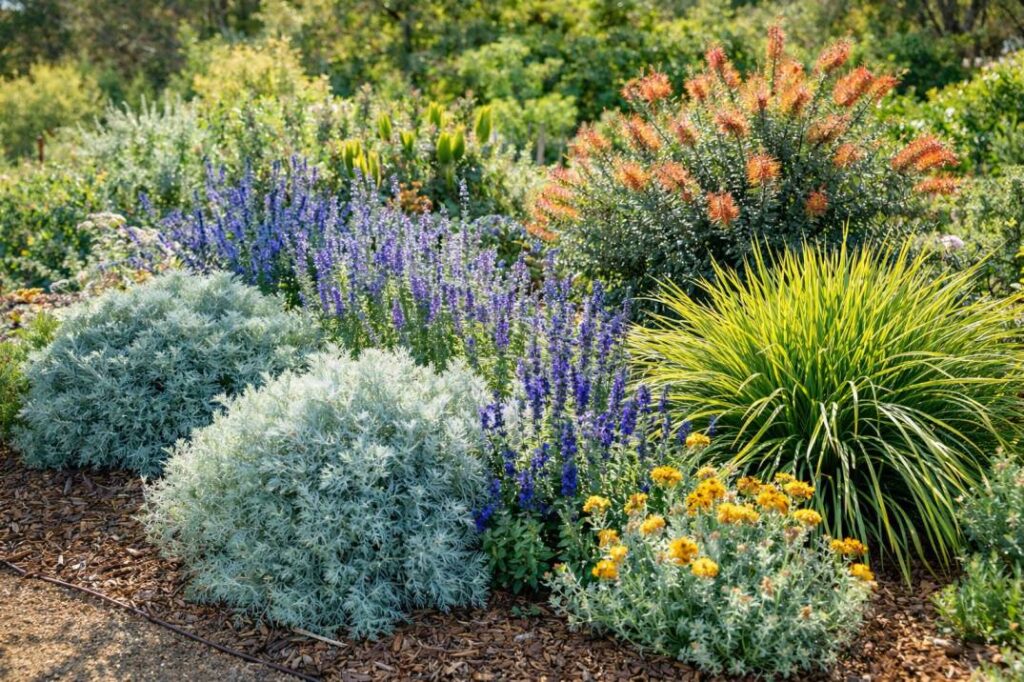
In my front yard, I’ve created what I call the “Silver and Blue Garden”:
- Blue: Australian Rosemary (Westringia), Lavender, Salvia
- Silver: Wormwood (Artemisia), Curry Plant (Helichrysum), Dusty Miller (Senecio)
- Structure: Pruned Olive trees, Rosemary standards
This combination looks stunning year-round, smells divine, and uses about 70% less water than a traditional garden bed.
Part 5: The Integration – Making Your System Sing
Connecting All the Dots
Here’s where your water wise backyard Australia transforms from pieces into a symphony. Let me walk you through my typical summer week:
Monday Morning
- 6:00 AM: Smart controller checks weather forecast and soil moisture
- 6:30 AM: Zone 1 (veggies) runs for 15 minutes via drip irrigation
- Water Source: Rainwater tank (primary), topped up by air conditioner condensation
Tuesday Morning
- 6:30 AM: Zone 2 (lawn and fruit trees) runs for 20 minutes
- Water Source: Rainwater tank (60%), greywater from laundry (40%)
Wednesday
- No automated watering
- Evening: I hand-water new plantings and check soil moisture manually
Thursday Morning
- 6:30 AM: Zone 3 (natives and drought-tolerant) runs for 10 minutes
- Water Source: Rainwater tank
Friday-Sunday
- Weather-dependent watering
- Saturday task: Check tank levels, clean gutter mesh, observe plant health
The Monitoring Ritual That Saves Thousands
Every Saturday morning with my coffee, I do my “water walk”:
- Check tank levels (I have simple sight gauges)
- Look for wet spots or dry patches
- Check mulch depth
- Observe plant leaf condition (slight wilting in afternoon heat is normal)
- Dig a small hole in one garden bed to check soil moisture at root level
This 15-minute ritual has helped me catch:
- A leaking joint that was losing 100 litres per day
- Ant nests in my drip lines
- Mulch that had blown thin
- Plants that needed moving to better positions
Seasonal Adjustments: Your System Isn’t Set-and-Forget
Spring (September-November)
- Reduce watering frequency but increase duration as plants grow
- Top up mulch before summer
- Service irrigation system: clean filters, check emitters
- Prepare for rainwater harvesting backyard Australia autumn rains by clearing gutters
Summer (December-February)
- Water in early morning only
- Consider adding temporary shade cloth for delicate plants
- Let lawns go dormant (they’ll green up with autumn rains)
- Harvest every possible drop of rain
Autumn (March-May)
- Gradually reduce watering as temperatures drop
- Plant new additions – they’ll establish over winter
- Take advantage of rainwater tank rebates Australia programs if upgrading
- Deep-soak garden beds before dry winter periods in some regions
Winter (June-August)
- Water only during dry spells
- Perfect time for irrigation maintenance
- Plan next season’s improvements
- Capture every drop of rain for summer storage
Part 6: Troubleshooting Common Problems
When Your System Isn’t Working
Problem: Wet spots in strange places
Likely cause: Leak in underground pipe or misaligned emitter
Fix: Follow the wet spot backward. Usually within 2 metres of the source. For underground leaks, look for unusually green grass patches.
Problem: Some plants thriving while others struggle on same line
Likely cause: Pressure problems or different water needs
Fix: Add pressure-compensating emitters or re-zone so similar plants are together
Problem: Tank never seems to fill
Likely cause: First flush diverter stuck open, gutter blockage, or incorrect sizing
Fix: Check diverter operation, clean gutters, calculate if your tank is oversized for your roof
Problem: Plants showing salt damage (brown leaf tips)
Likely cause: Greywater salt buildup or insufficient leaching
Fix: Switch to rainwater only for 2-3 waterings, ensure 20% extra water for leaching when using greywater
The Cost Reality: Investing in Your System
Let’s talk dollars. Here’s what I’ve invested over 10 years:
Initial Setup (Year 1):
- 2,000L rainwater tank and plumbing: $1,200
- Basic drip irrigation for veggie patch: $300
- Soil improvements (gypsum, compost): $500
- Drought-tolerant plants: $400
- Total: $2,400
Expansion (Years 2-3):
- Additional 5,500L tank capacity: $1,800
- Smart controller and sensors: $600
- Expanded irrigation to whole garden: $800
- Total: $3,200
Maintenance (Annual, Years 4-10):
- Plants and seeds: $200
- Mulch and compost: $300
- Irrigation parts replacement: $100
- Total per year: $600
Water Bill Savings:
- Before system: $800-1,200/year (depending on restrictions)
- After system: $200-400/year
- Annual saving: $600-800
Payback period: About 7-8 years for full system, but immediate quality of life improvement
The real value isn’t just dollar savings. It’s the resilience during droughts, the food production, the habitat creation, and the sheer enjoyment of a garden that works with nature.
Part 7: Taking It Further – Advanced Techniques
Creating a Food Forest That Waters Itself
My current project is a water-wise food forest based on permaculture principles. The seven-layer system:
- Canopy: Fruit trees (dwarf varieties)
- Understory: Berry shrubs
- Shrub layer: Herbs and tea plants
- Herbaceous: Vegetables and flowers
- Groundcover: Edible creepers
- Root zone: Root vegetables
- Vertical layer: Climbers (beans, passionfruit)
Each layer protects the others from sun and wind, dramatically reducing water needs. The heavy mulch layer (20cm in this system) creates a fungal-dominant soil that holds moisture exceptionally well.
The Wildlife Factor: Creating a Balanced Ecosystem
A truly resilient water wise backyard Australia includes animals – not as pests, but as partners.
The Lizard Lounge
I’ve created basking rocks near my vegetable garden. The blue-tongue lizards that live there eat snails and slugs – reducing my pest problems without chemicals.
The Frog Hotel
A small pond (with a solar pump to keep water moving) provides habitat for frogs. They’re excellent insect controllers. The pond also creates a cool microclimate that reduces evaporation from nearby plants.
The Bird Bath Strategy
Multiple bird baths at different heights attract insect-eating birds. I use saucers on poles, on the ground, and hanging. Changing the water daily in summer provides drinking spots so birds don’t peck at fruits looking for moisture.
Technology Frontiers: What’s Next for Water-Wise Gardening
Soil Moisture Sensing Networks
Instead of one sensor, imagine a network of cheap sensors throughout your garden, giving you a complete soil moisture map via your phone.
AI-Powered Plant Recognition
Apps that can identify plants from a photo and tell you their specific water needs compared to what they’re receiving.
Predictive Watering Algorithms
Systems that don’t just react to current conditions but learn your garden’s patterns and predict needs based on plant growth stage, weather forecasts, and historical data.
I’m currently experimenting with a simple Arduino-based system that monitors five points in my garden and texts me when any zone drops below ideal moisture. Total cost: about $120 in parts.
Conclusion: Your Water-Wise Legacy
Creating a complete water wise backyard Australia system from tanks to taps isn’t a weekend project. It’s a journey that evolves with your knowledge and your garden.
Start small. Maybe this month you’ll install a rainwater tank diverter on one downpipe. Next season, you’ll convert one garden bed to drip irrigation. The following year, you’ll replace your thirstiest plants with drought-tolerant alternatives.
Each step moves you toward something remarkable: a garden that doesn’t just survive Australian conditions but celebrates them. A space that teaches you about resilience, about working with natural systems, about the quiet satisfaction of creating abundance from limited resources.
The greatest lesson my water wise backyard Australia has taught me? That efficiency isn’t about scarcity – it’s about creating more life with every drop. It’s about understanding that in this ancient, dry land, water is life itself, and how we steward it in our little patches of earth matters more than we know.
Your journey starts with that first step. Maybe it’s watching where water flows in your yard after rain. Maybe it’s finally fixing that leaking tap. Maybe it’s simply standing in your garden with a morning cuppa and asking, “Where does my water come from, and where does it go?”
However you begin, begin. The path to a truly water-wise backyard is waiting. And every drop saved along the way is a victory – for your garden, for your wallet, and for this beautiful, thirsty country we call home.
Ready to take the next step? Explore our complete Water & Rain category for more guides, or start with our practical tips on water saving tips backyard Australia that you can implement this weekend.