
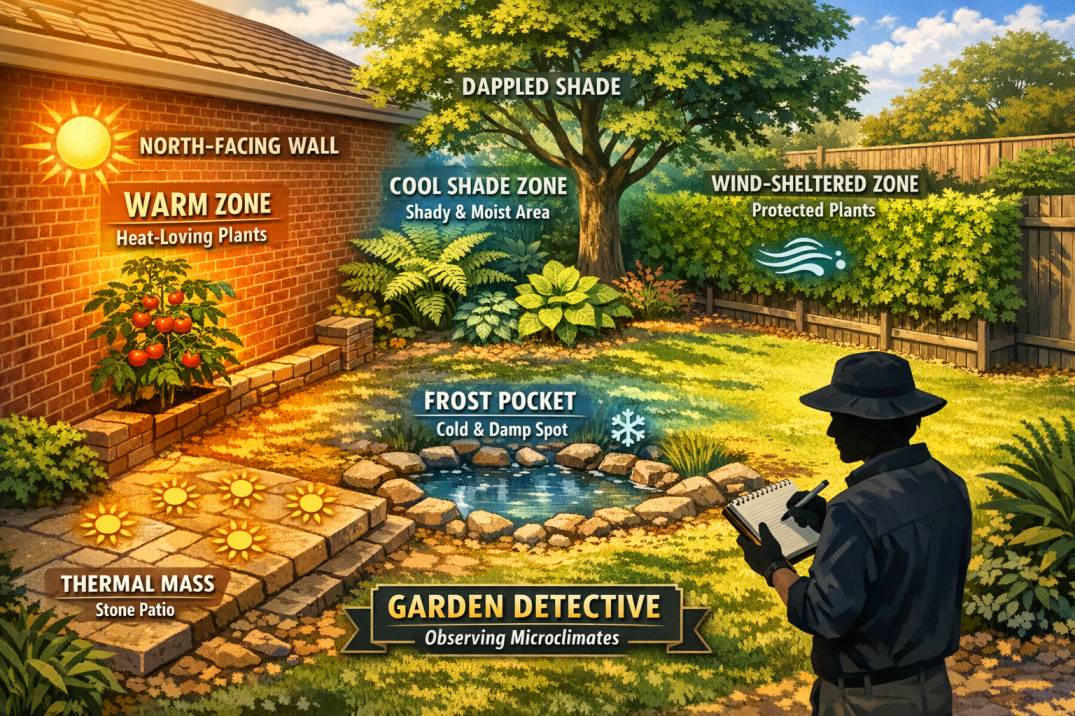
Garden microclimates Australia, it sounds like a fancy term, doesn’t it? But here’s the thing: you’re probably already using them without even realising. That sunny spot against your north-facing brick wall where tomatoes ripen weeks earlier? That’s a microclimate. The damp, shady corner under the fence where ferns thrive? That’s another one.
G’day, I’m Hasan. After years of gardening in Melbourne’s unpredictable weather, I’ve learned that understanding your garden’s microclimates is the secret weapon of successful growers. It’s not about fighting your conditions. It’s about working with them, and sometimes even creating better ones.
This guide will show you how to find the microclimates you already have, how to make new ones, and how to use them to grow plants that “shouldn’t” be possible in your area. Let’s turn your whole yard into a thriving, productive oasis.
Table of Contents
What Exactly Are Garden Microclimates?
Let’s start simple. A microclimate is a small area within your garden that has different conditions to the general climate of your region . It might be warmer, cooler, wetter, drier, or more sheltered than the rest of your yard.
Think about your own place. The front yard might bake in summer while the back corner stays cool and damp. The spot next to the clothesline might get hammered by wind, while the veggie patch behind the shed is perfectly calm. These differences are microclimates, and they matter enormously for what you can grow where.
Understanding garden microclimates Australia-wide is especially important because our continent is so diverse. What works in Sydney won’t work in Perth. But even within a single suburb, your garden can be totally different from your neighbour’s.
Step 1: Know Your Big-Picture Climate First
Before you can understand your microclimates, you need to know your regional climate. Australia is broadly divided into several climate zones :
| Climate Zone | Characteristics | Example Locations |
|---|---|---|
| Tropical | High humidity, summer rainfall, warm dry winters | Cairns, Darwin, Broome |
| Subtropical | Warm humid summers, mild dry winters | Brisbane, Gold Coast, Coffs Harbour |
| Temperate | Four distinct seasons, reliable rainfall | Sydney, Wollongong, Newcastle |
| Cool Temperate | Cold winters with frost/snow, hot dry summers | Melbourne, Canberra, Hobart, Ballarat |
| Mediterranean | Hot dry summers, cool wet winters | Perth, Adelaide, Albany |
| Arid Interior | Hot dry summers, variable winters | Alice Springs, Mildura, Dubbo |
Your regional climate gives you the big-picture rules. Your microclimates are where you get to bend them.
Step 2: Become a Garden Detective
Ready to find your microclimates? Grab a cuppa, a notebook, and spend a day observing. Here’s what to look for :
Sun and Shadow Patterns:
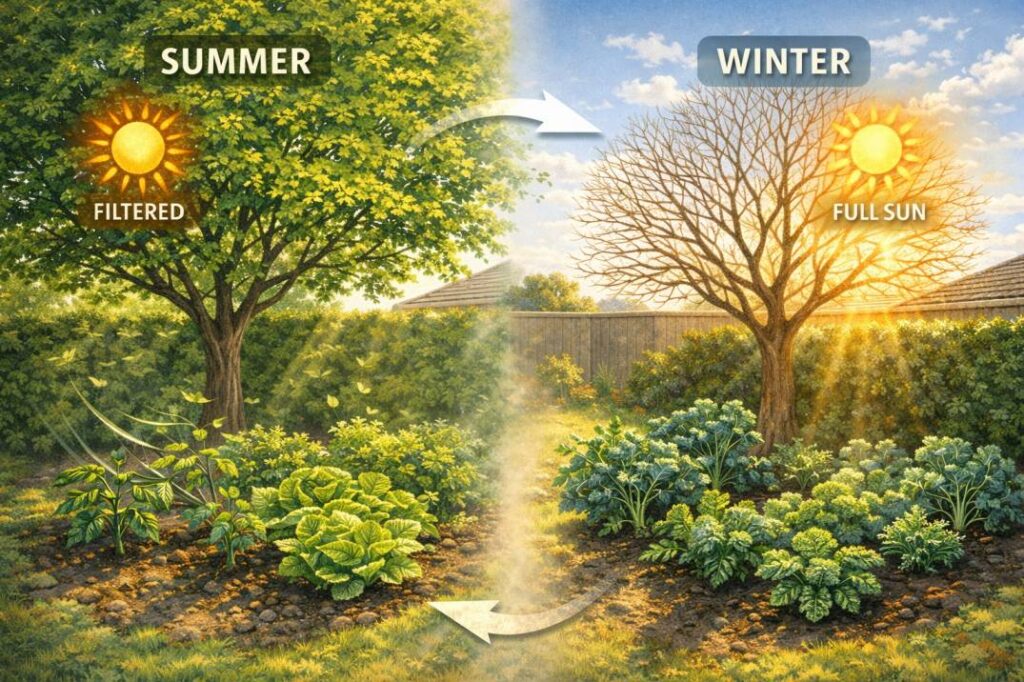
Walk your garden at 9am, 12pm, and 3pm on a sunny day. Mark where shadows fall. The spots that get full winter sun but summer shade are absolute gold for certain plants.
Wind Tunnels:
Feel where the wind funnels between the house and fence, or whips around corners. These spots will need extra protection.
Frost Pockets:
Cold air flows downhill like water. It pools in low spots. If you wake to frost in some areas but not others, you’ve found a frost hollow .
Damp Zones:
Notice where water lingers after rain, or where the soil dries out fastest. These are your wet and dry microclimates.
The House Factor:
Your house creates its own climate. North-facing walls soak up heat and radiate it at night. South-facing walls stay cool and shaded. East sides get gentle morning sun. West sides cop the harsh afternoon blaze.
Step 3: Create Warm Microclimates (For Tender Plants and Extended Seasons)
Want to grow tomatoes in Hobart? Ripen capsicums in chilly Melbourne? Warm microclimates are your answer.
Use Thermal Mass
Materials like brick, stone, and concrete absorb heat during the day and release it slowly at night . This can raise overnight temperatures by several degrees, enough to protect against light frost.
How to do it:
- Plant tender crops against north-facing brick walls.
- Use stone pavers or large rocks in your garden beds.
- Fill dark-coloured pots with water and place them among plants (they heat up during the day and radiate warmth overnight).
Build a Cold Frame or Greenhouse
In cool climates, a simple cold frame can extend your growing season by months .
DIY Cold Frame:
Rest an old window on a rectangle of bricks, leaving space in the middle for seedlings. It’s that simple. Position it facing north, and you’ve created a warm, protected nursery.
A full greenhouse is a bigger investment, but if you have space, it’s a game-changer for cold-climate gardeners .
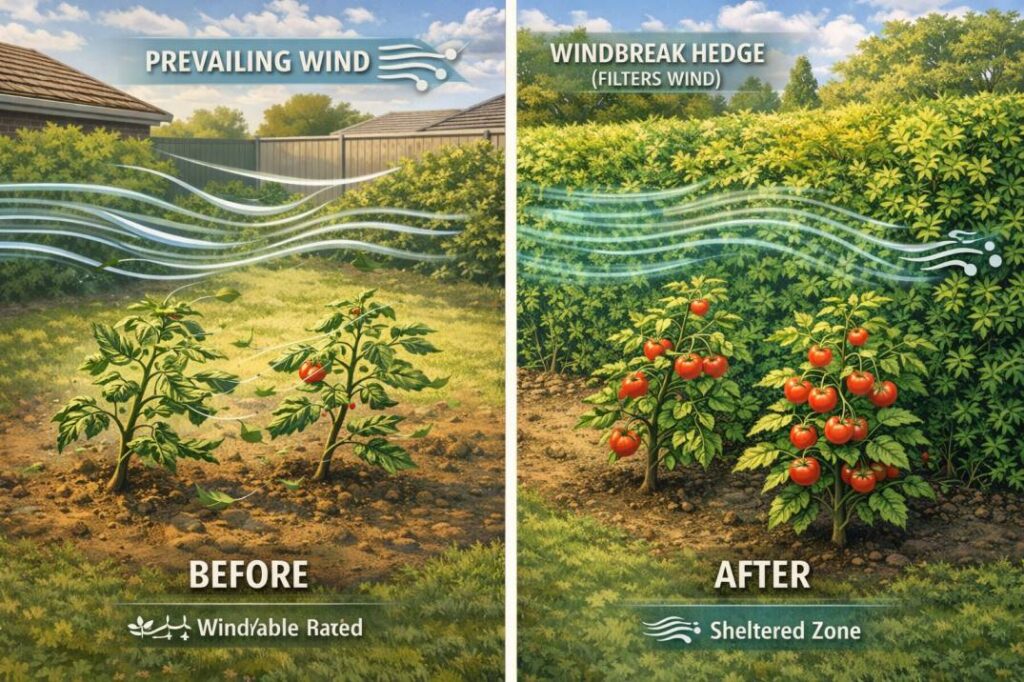
Create Windbreaks
Wind strips moisture and heat from plants. A good windbreak can slow wind speed by up to 80% .
Shrubby windbreaks are best because they filter the wind rather than blocking it completely. Solid walls can create turbulence on the other side .
Great plants for windbreaks:
- Native: Sticky hopbush, Westringia, Tea tree, Acacias, Saltbush, Eremophilas .
- Non-native: English lavender, Photinia, Teucrium, Rosemary, Feijoa .
Design tips:
- Plant at 1 metre spacing for a dense hedge .
- Aim for about 40% porosity – sparse enough for wind to flow through, dense enough to slow it down .
- Position windbreaks perpendicular to the prevailing wind .
Step 4: Create Cool Microclimates (For Heat-Sensitive Plants)
In scorching Australian summers, cool microclimates are just as precious as warm ones.
Shade, Shade, Shade
When you create shade in garden spaces, you can drop temperatures by several degrees .
Deciduous trees are perfect – they shade in summer but let sun through in winter . Ornamental pears and jacarandas are excellent choices .
For faster results:
- Install shade cloth panels over veggie beds .
- Use shade sails over seating areas or play spaces .
- Plant climbing vines like grapes or passionfruit over pergolas .
- Position pots where they’ll be shaded during the hottest part of the day.
Use Evaporative Cooling
Water features do more than look pretty. They cool the air around them .
When prevailing winds blow across a pond, they pick up moisture and cool down before reaching your plants . Even a simple bird bath helps.
Budget-friendly options:
- Solar-powered fountain pumps .
- Misting hose attachments .
- Shallow basins of water placed strategically .
Reflective Surfaces
In hot climates, light-coloured surfaces reflect heat away from plants . Think white-painted walls, light-coloured gravel, or corrugated iron that faces away from tender crops.
Step 5: Master Frost Protection Australia-Style
Frost is the enemy of so many beloved plants. But with smart microclimate management, you can outwit it.
Know Your Frost Pockets
As mentioned, cold air sinks. If your garden slopes, the lowest spots will get the worst frost . Plant frost-tender species on higher ground or slopes where cold air drains away.
Use Canopy Protection
Trees and large shrubs can create a protective umbrella. In the Woodland Garden example, eucalyptus trees provide overhead protection that mitigates severe frost for underplantings .
Create Instant Protection
For precious plants, temporary measures can save the day:
- Tree guards or corflute protectors create a nurturing micro-climate for young plants .
- Cloches made from poly pipe covered with clear plastic work wonders .
- Frost cloth draped over plants on cold nights traps ground heat.
The Water Trick
Water is thermal mass. On still, clear nights, a pond or even buckets of water placed near vulnerable plants can absorb heat during the day and release it overnight, sometimes preventing frost damage .
Step 6: Manage Wet and Dry Microclimates
Dealing with Excess Moisture
Some spots are naturally damp, near downpipes, in low-lying areas, or where shade prevents evaporation.
Solutions for wet areas:
- Choose plants that love moisture (many ferns, some native grasses).
- Improve drainage with raised beds or mounds.
- During very wet seasons, cover resting beds with silage tarp to control how much rain hits the soil .
Coping with Dry Spots
South-facing slopes, sandy areas, and spots under large trees dry out fastest.
Solutions for dry areas:
- Choose drought-tolerant plants (Mediterranean herbs, many Australian natives).
- Mulch heavily to retain moisture.
- Use ollas or drip irrigation for targeted watering.
- Group plants with similar water needs together.
Step 7: Put It All Together – Your Microclimate Garden Plan
Now for the fun part. Use your microclimate knowledge to design a smarter garden.
Create a Sunshine and Shadow Drawing
Before you plant anything, draw a simple map of your garden. Mark the sun and shade patterns at different times . This becomes your master plan.
Match Plants to Spots
- Warm, sheltered north-facing wall: Tomatoes, capsicums, basil, lemons.
- Cool, shady south side: Ferns, hostas, native violets, woodland plants.
- Hot, dry, windy spot: Lavender, rosemary, saltbush, Westringia .
- Damp, low-lying area: Ligularia, astilbes, some native grasses.
- Frost-prone hollow: Frost-tough plants only (many deciduous trees, some grevilleas).
Stack Your Microclimates
The real magic happens when you combine techniques. Plant a windbreak, then put a pond in the sheltered zone, then position heat-loving plants against a north-facing wall behind the pond. You’ve just created a mini oasis.
Learn from Tiny Forests
The “tiny forest” concept shows what’s possible. By densely planting native species and using tree guards to create nurturing microclimates, young forests establish 10 times faster than usual . The same principle applies in your garden – protect young plants while they get established, and they’ll thrive faster.
Common Microclimate Mistakes
- Ignoring Your House: Your biggest asset! Use those walls. A north-facing brick wall is a free greenhouse.
- Planting Without Observation: Rushing in without watching your sun and shade patterns leads to sad, struggling plants.
- Creating Wind Tunnels: Solid fences can make wind worse by funnelling it. Use porous barriers instead .
- Forgetting About Frost: Planting tender species in low spots is asking for trouble.
- Overlooking Microclimates You Create: Your compost heap generates heat. Your rainwater tank creates shade. Your paving radiates warmth. Use these!
Frequently Asked Questions
Q: How do I measure my microclimates?
A: Start simple, just observe. For more precision, use a maximum/minimum thermometer placed in different spots. Check soil moisture with your finger or a moisture meter. Note frost patterns on cold mornings.
Q: Can I really grow plants from a warmer climate using microclimates?
A: Yes, within reason. A warm microclimate can extend your range by one plant hardiness zone, sometimes two. You might grow a lemon in a cool temperate area against a north wall, but you probably won’t grow mangoes in Melbourne.
Q: How do I protect my garden from extreme heat?
A: Combine several strategies: shade cloth, deep mulch, regular watering at roots (not leaves), and grouping plants to create mutual shelter. Creating shade in garden spaces is your number one defence .
Q: What are the best plants for windbreaks in small gardens?
A: For small spaces, choose plants that can be hedged and maintained at a manageable height. Sticky hopbush, Westringia, and rosemary are excellent choices . They’re tough, easy to prune, and provide great protection.
Q: How does microclimate knowledge help with saving seeds?
A: Great question! When you save seeds Australia-wide, you’re selecting plants that have thrived in your specific conditions. Over time, your saved seeds become adapted to your unique microclimates. It’s the ultimate in personalised gardening.
Conclusion: Your Garden, Your Climate, Your Way
Understanding garden microclimates Australia-wide transforms how you garden. You stop fighting your conditions and start working with them. You learn to see your yard not as one uniform space, but as a collection of unique spots, each with its own personality and potential.
Start small this season. Map your sun and shade. Feel where the wind hits. Notice where frost settles. Then make one small change – plant a heat-lover against that warm wall, put a shade-loving fern in that cool corner, or install a simple windbreak.
Your garden will thank you with healthier plants, better harvests, and more joy for you.
Ready to build on this foundation? A healthy garden starts with healthy soil. Learn how to improve your garden soil Australia-wide to give your plants the best possible start. And for a garden that buzzes with life, discover how to attract pollinators Australia to your newly optimised microclimates.