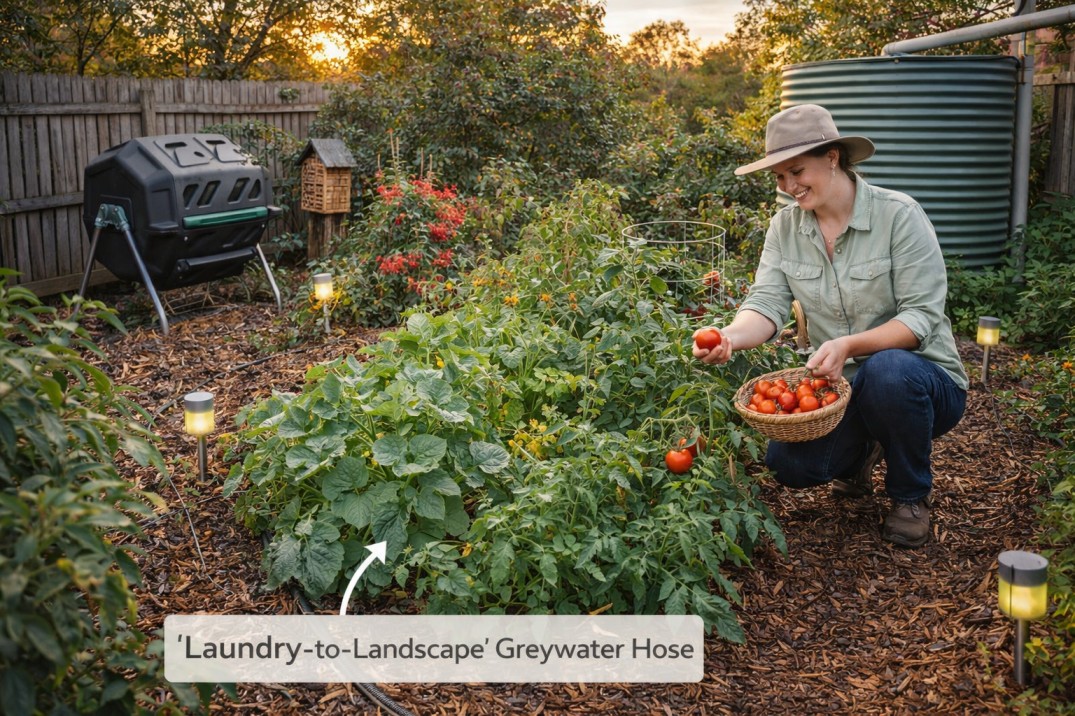
Can you hear that sound? It’s the sound of your sprinkler running in the middle of the day. The sound of your green bin being wheeled to the curb. The sound of your wallet getting thinner as you buy herbs, fertiliser, and soil. It’s the sound of the old way, a system that takes more than it gives.
Now, imagine a different sound. The buzz of native bees visiting your flowers. The gentle “plink” of rain filling a barrel. The satisfying crunch of a carrot you grew yourself. This is the sound of a sustainable backyard.
I want to tell you a quick story. Five years ago, I stood on my brown, crispy lawn in Western Sydney during a heatwave. I was paying $200 a quarter for water, mostly to keep that sad grass alive. I felt guilty, frustrated, and completely disconnected from the land I lived on. Today, that same space provides food for my family, habitat for wildlife, and has cut my water use by 60%. I didn’t do it with a big budget or expert skills. I did it by implementing simple, powerful backyard sustainability ideas Australia-style, projects designed for our unique climate and challenges.
This guide isn’t about becoming an eco-warrior overnight. It’s about seven practical shifts that create real change. Whether you have a sprawling backyard or a tiny balcony, these backyard sustainability ideas Australia will help you create a space that gives back more than it takes. Let’s begin.
Table of Contents
What Does “Sustainable” Really Mean in the Australian Context?
Before we get to the “how,” let’s get clear on the “why.” In Australia, sustainability isn’t just a nice idea, it’s about resilience and adaptation.
Our challenges are specific: Scorching summers. Prolonged droughts. Intense UV radiation. Declining native species. Bushfire risks.
A truly sustainable Australian backyard directly addresses these issues by becoming:
- A water bank that captures and stores every possible drop
- A cooling system that reduces local temperatures
- A wildlife corridor in our suburban landscapes
- A food source that reduces your food miles
- A carbon sink that pulls CO₂ from the atmosphere
When we talk about backyard sustainability ideas Australia, we’re talking about practical solutions to these very real Australian problems. Your backyard can become part of the solution.
Idea 1: Master the Art of Water Wisdom (Your First Priority)
In Australia, water is life. It’s also expensive and increasingly scarce. The most important of all backyard sustainability ideas Australia is becoming a water genius.
The Fix-It Audit: Start with this simple Saturday morning task. Turn on every outdoor tap and walk the path. Look for drips, leaks, and soggy patches. A single dripping tap can waste 20,000+ litres annually, that’s literally money flowing into the ground. The $3 washer you’ll replace it with has one of the best returns on investment you’ll ever get.
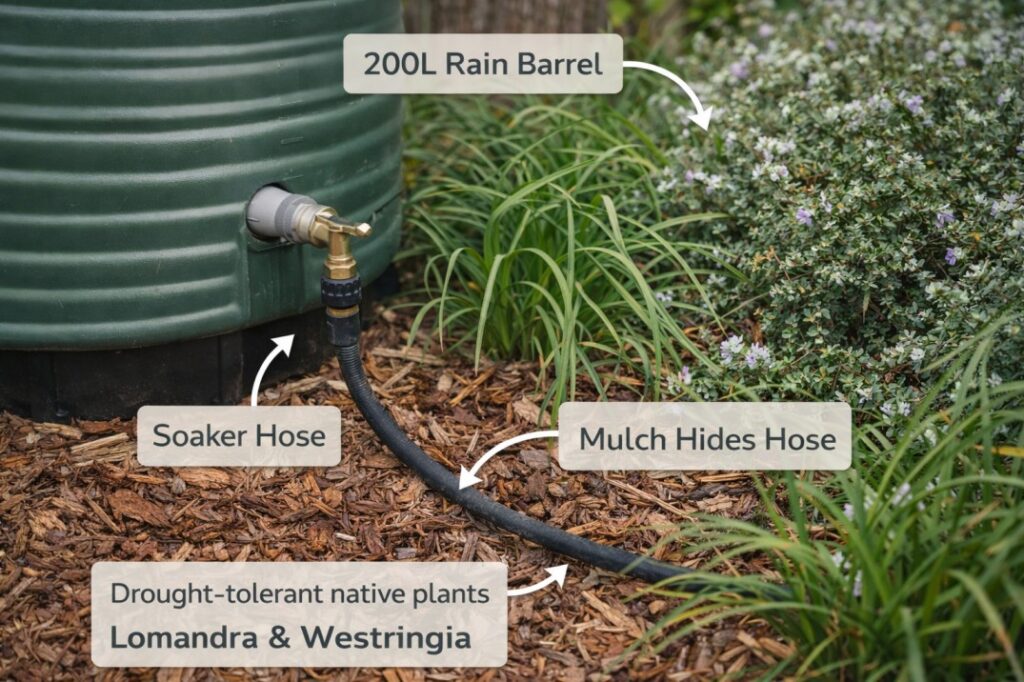
The Mulch Revolution: This is where most beginners underestimate the power of simple solutions. Bare soil isn’t just ugly, it’s evaporating precious moisture and baking in the sun. Apply 7-10cm of organic mulch (I prefer sugar cane mulch or wood chips) to every exposed soil surface. Here’s what happens:
- Water evaporation reduces by up to 70%
- Soil temperature stabilises (crucial for root health)
- Weeds are suppressed naturally
- Organic matter slowly breaks down to feed your soil
Smart Watering Habits: Water deeply but less frequently. This encourages plants to develop deep root systems that are more drought-resistant. Always water in the early morning or late afternoon to minimise evaporation. Better yet, install a simple drip irrigation system on a timer, it delivers water directly to roots with almost zero waste.
Idea 2: Build Your Soil with Composting (The Foundation of Everything)
Healthy soil is the secret engine of every productive garden. In Australia, where our soils are often ancient and nutrient-poor, building soil isn’t optional, it’s essential.
Why This Changes Everything: When you send organic waste to landfill, it decomposes without oxygen and produces methane, a greenhouse gas 28 times more potent than CO₂. When you compost at home, you’re running your own personal methane-prevention plant while creating the best fertiliser money can’t buy.
The Simple Start That Works: Forget complicated ratios. Here’s my foolproof method:
- Get two buckets. Label one “Greens” (kitchen scraps, coffee grounds, fresh grass). Label the other “Browns” (dry leaves, shredded paper, cardboard).
- Every time you fill the Greens bucket, empty it into your compost bin and cover it with two buckets of Browns.
- Keep it moist like a wrung-out sponge.
- Turn it monthly with a garden fork.
That’s it. In 3-6 months, you’ll have black gold. For a complete guide to getting this right, our Australian Composting Guide walks you through every step.
The Game-Changer: Worm farms. If you’re short on space or want faster results, set up a worm farm. They’re odorless, perfect for balconies, and produce both solid castings and nutrient-rich “worm tea” liquid fertiliser. I’ve had one on my apartment balcony for three years, it’s the secret to my container garden’s success.
Idea 3: Plant for Your Place (The “Right Plant, Right Place” Revolution)
Trying to grow English cottage garden plants in the Australian sun is like trying to run an air conditioner with the windows open. It’s a constant, losing battle.
The Native Advantage: Australian native plants aren’t just drought-tolerant, they’re drought-adapted. They’ve evolved over millions of years to thrive in our conditions. But here’s the insider tip: go hyper-local. Plants indigenous to your specific area will outperform even other Australian natives. Your local council website or a native plant nursery can tell you what’s truly local.
My Top 5 Foolproof Australian Native Plants:
- Lomandra – The ultimate tough grass-like plant
- Dianella – Beautiful foliage with purple berries
- Westringia – Neat, flowering shrub that thrives on neglect
- Callistemon (Bottlebrush) – Bird and bee magnet
- Kangaroo Paw – Stunning flowers that last for weeks
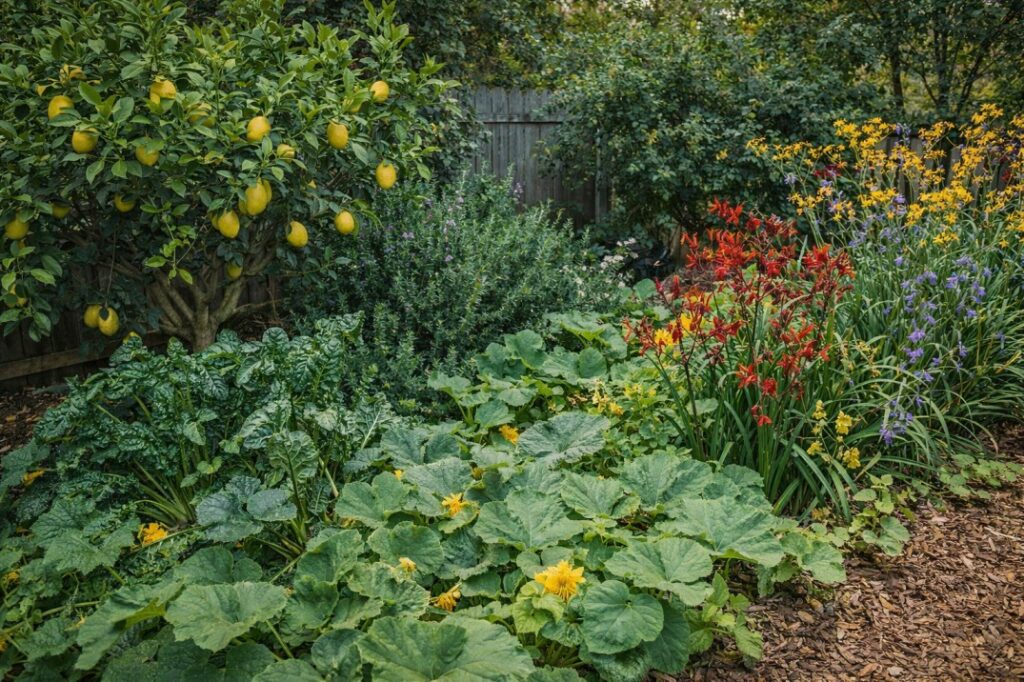
The Food Forest Concept: This is one of the most exciting backyard sustainability ideas Australia has embraced. Instead of a traditional veggie patch, create layers:
- Canopy: Fruit trees (dwarf varieties for small spaces)
- Shrub layer: Berries (blueberries, raspberries)
- Herb layer: Rosemary, thyme, oregano
- Ground cover: Sweet potato, pumpkin
- Root layer: Carrots, potatoes
This creates a self-sustaining ecosystem that mimics nature, reduces water needs, and produces abundant food.
Idea 4: Harvest the Rain (Every Single Drop)
Australia is the land of drought and flooding rain. The smart approach? Catch the flood to survive the drought.
Start Small, Think Big: A simple 200L rain barrel connected to one downpipe costs under $100 and can capture thousands of litres annually. Position it near your veggie patch or greenhouse for easy watering.
The Pro Move: Install a first-flush diverter. This clever device ($30-$80) diverts the first, dirtiest 10-20 litres of rainwater (carrying roof dust and bird droppings) away from your tank. Your stored water stays cleaner longer.
Beyond the Tank: Create “swales”, shallow ditches dug along the contour of your land. They slow rainwater runoff, allowing it to soak into the soil rather than washing away. Plant water-loving plants (like some native sedges) in these swales, and they’ll thrive with zero extra watering.
Idea 5: Welcome the Helpers (Create a Living Ecosystem)
A sustainable garden isn’t just plants, it’s a complete ecosystem. Your job is to recruit the right team members.
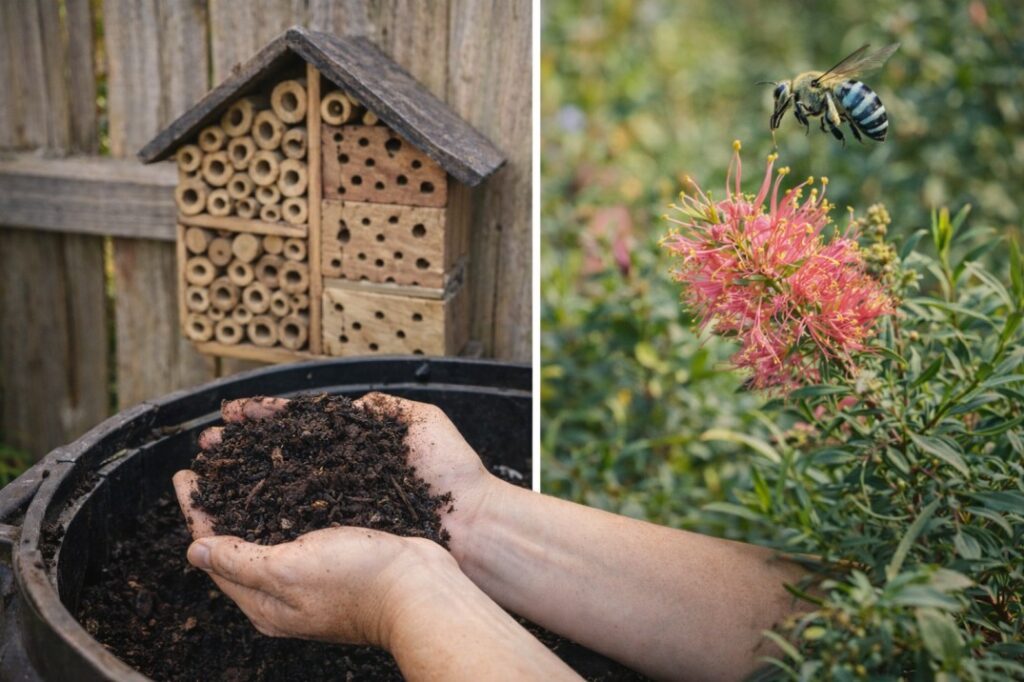
Build a Five-Star Bug Hotel: Use recycled materials to create different “rooms”:
- Bamboo tubes for solitary bees
- Pine cones and bark for ladybirds
- Corrugated cardboard for lacewings
- Terracotta pots filled with straw for spiders
Place it in a north-facing, sheltered spot. You’re not attracting pests, you’re attracting the predators that eat pests.
The Bird and Bee Cafe: Install a shallow bird bath with stones for perching (to prevent drowning). Keep it clean and topped up, especially in summer. Plant flowering natives nearby to provide nectar. Watch as your garden comes alive with helpful visitors.
Leave the “Mess”: A perfectly manicured garden is a wildlife desert. Allow some leaf litter to accumulate under shrubs. Leave a dead log in a corner. These provide crucial habitat for insects, fungi, and microorganisms that keep your soil healthy.
Idea 6: Rethink Your Lawn (The Great Australian Grass Dilemma)
The traditional Australian lawn is a triple threat: water-hungry, chemical-dependent, and high-maintenance. You don’t need to remove it all, but you can make it smarter.
The Shrink Strategy: Replace lawn edges with garden beds. Each metre you convert saves hundreds of litres of water annually. Use native groundcovers like Myoporum or Kidney Weed (Dichondra repens) for green coverage without the grass maintenance.
Mow Smarter, Not Harder: Set your mower to its highest setting. Longer grass shades its roots, needs less water, and withstands heat better. Consider a manual push mower for small lawns, they’re silent, emission-free, and surprisingly effective.
When to Replace: If you’re starting fresh or renovating, consider these alternatives:
- Buffalo grass varieties like ‘Sir Walter’ – more drought-tolerant
- Native lawn mixes – slower growing but much hardier
- Clover lawns – stay green with less water, fix nitrogen in soil
Idea 7: Harness the Sun (Smart Solar Solutions)
Australia has some of the best solar resources in the world. Why not use them in your garden?
Solar Lighting Done Right: Modern solar LED lights have improved dramatically. Look for models with separate solar panels (so you can place the panel in sun, the light in shade). They provide ample light for pathways and can last for years.
Solar-Powered Water Features: A small solar fountain pump ($40-$80) can oxygenate a pond or create a soothing water feature without any electrical cords. Moving water also discourages mosquitoes.
The Ultimate Solar Hack – Food Preservation: Build a simple solar dehydrator from an old window frame and some mesh trays. Use it to dry herbs, fruits, and vegetables from your garden. You’re preserving food without using your kitchen electricity, and solar-dried food retains more nutrients than oven-dried.
Your First Month Action Plan
Don’t try to do everything at once. Here’s a realistic month-long plan:
Week 1: The Water Audit
- Fix any leaking taps or connections
- Install a rain gauge
- Mulch one garden bed
- Put a bucket in your shower to catch “warm-up” water for plants
Week 2: Start the Cycle
- Set up a compost system or worm farm
- Begin collecting kitchen scraps
- Visit a native nursery and buy one locally indigenous plant
Week 3: Welcome Wildlife
- Build or buy a simple bug hotel
- Install a bird bath
- Leave one “messy” corner with leaf litter
Week 4: Capture and Convert
- Install a rain barrel on one downpipe
- Replace one outdoor light with a solar version
- Plan one section of lawn to convert next season
Backyard Sustainability Ideas Australia: Your Questions Answered
Q: I’m renting. Are these ideas still possible for me?
A: Absolutely! Focus on portable systems: container gardens with native plants, a worm farm (most landlords are fine with this), a standalone rain barrel not plumbed in, and potted fruit trees. You can take your soil improvements with you when you move. Many backyard sustainability ideas Australia are perfect for renters.
Q: Won’t attracting insects mean more pests in my garden?
A: Actually, the opposite is true. A diverse insect population creates balance. Ladybirds eat aphids. Lacewings eat mites. Parasitic wasps control caterpillars. By providing habitat for these beneficial insects, you’re creating a natural pest control army. The problems occur when we use broad-spectrum pesticides that kill the good bugs along with the bad.
Q: Is composting difficult or smelly?
A: A properly maintained compost pile should smell like fresh earth, not rubbish. The key is balancing “greens” (nitrogen) with “browns” (carbon). If it smells bad, add more browns like dry leaves or shredded paper. It’s much easier than most people think. For handling just food scraps efficiently, check out our guide to composting kitchen waste Australia.
Q: How much time does maintaining a sustainable backyard really take?
A: Less than maintaining a conventional one once it’s established. Native plants need less pruning and watering. Healthy soil means fewer pest problems. Composting takes minutes per week. The initial setup requires time, but the long-term maintenance is significantly reduced. You’re trading weekend lawn mowing for Saturday morning harvests.
Q: Can I really make a difference with just my small backyard?
A: Yes, in three important ways:
- The Ripple Effect: Your garden can be a seed source for neighbors, a habitat corridor connecting larger green spaces, and an educational example for your community.
- The Cumulative Impact: If 1,000 homes each saved 20,000 litres of water annually, that’s 20 million litres. Change scales beautifully.
- The Personal Shift: The greatest impact might be on you, changing how you see your relationship with the natural world.
Q: What’s the one thing I should do first?
A: Start observing. Notice where the sun falls at different times of day. Notice where water pools when it rains. Notice what’s already growing well. Then, start with water, fix leaks and add mulch. Water wisdom informs every other decision.
The Real Reward Beyond Sustainability
Here’s what nobody tells you about implementing backyard sustainability ideas Australia: the benefits go far beyond lower bills and less waste.
You’ll develop a deeper connection to the seasons. You’ll notice the first bees of spring, the changing angle of autumn light, the way certain plants respond to summer storms. You’ll develop what I call “gardener’s patience”, the understanding that good things take time but are worth waiting for.
Your backyard becomes a place of discovery, especially if you have children. My kids now know where their food comes from. They can identify native bees. They understand the water cycle because they see it in action in our rain barrels and swales.
Most importantly, you’ll replace that helpless feeling with agency. In a world of big, scary environmental problems, your backyard becomes a place where you can see tangible progress. Where you can point and say, “I helped create that.”
The sound of a sustainable backyard isn’t silence. It’s life. It’s abundance. It’s resilience. And it starts with your decision to take that first step today.
1 thought on “7 Brilliant Backyard Sustainability Ideas Australia for Any Budget (2026 Guide)”